Go beyond payments

Most payment providers don't do enough for your business

New technologies have made it easier than ever to simply process payments. But not every payment provider includes all the crucial commerce elements required to meet customer needs. In fact, our research shows many companies spend a significant portion of their revenue (more than 11 percent) chasing after core needs that were not included in their payment solution.

Successful online commerce demands more

To build lasting customer relationships, you need a commerce solution that goes beyond payments and includes everything you need to reach customers with appropriate messages for each stage in the purchase lifecycle. In this whitepaper, 2Checkout outlines the key demands of online commerce that most payment providers do not meet, and reveals the combination of commerce, optimization, and distribution that will capture customers' attention.

What you'll learn from this resource

Download this whitepaper now and find out how a complete commerce solution:

  • Goes beyond the efforts of typical payment providers
  • The key elements of commerce that capture customer attention
  • Offers new options for global distribution
  • Supports conversion optimization techniques to boost the bottom line
go-beyond-payments.png

Integrate Zen Cart

Overview

Integrate Zen Cart to be able to process payments through the 2Checkout platform in over 200 countries and more than 100 currencies.

Zen Cart provides a complete package of solutions to different aspects of online business (features like billing, product display, multi-language options, different currencies, etc.)​.

Availability

Before you are able to start accepting payments, you need to request and finalize the activation of your live account by completing a form, and provide information that will help us verify the business and identity of the individuals involved in your business.

Zen Cart integration is available only for 2Checkout accounts that handle their own tax and invoice management (2Sell and 2Subscribe).

Zen Cart Settings

Perform the below set of instructions in your Zen Cart account to integrate it with 2Checkout.

  1. Download the 2Checkout payment module from GitHub.
  2. Upload the files to your server under your store’s directory.
  3. Log in to your Zen Cart admin panel.
  4. Navigate to Modules and click on Payment.
    Integrate_Zen_Cart_1.jpg
  5. On the Payment Modules page, select 2Checkout API, 2Checkout Convert Plus, or 2Checkout InLine and click on Install Module, as shown below.
    Integrate_Zen_Cart_2.jpg
  6. Enter your 2Checkout information:

    • your Seller ID. The Seller ID is your 2Checkout Merchant Code, and you can find it in the 2Checkout Merchant Control Panel, under Integration → Webhooks and API.
    • your Secret Key. You can find it in the 2Checkout Merchant Control Panel, under Integration → Webhooks and API
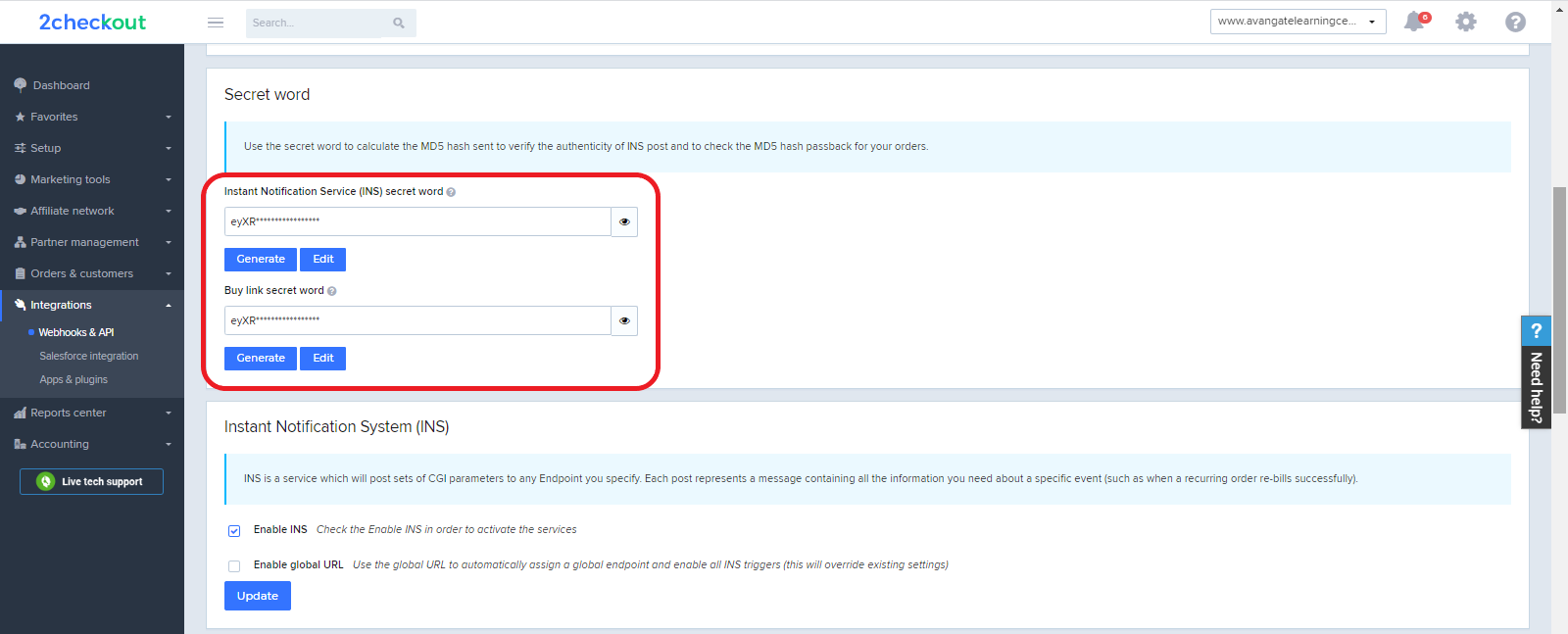
    • your Secret Word. The Secret Word is your 2Checkout Buy-Link Secret Word and you can find it in the 2Checkout Merchant Control Panel, under Integration → Webhooks and API.

    Integrate_Zen_Cart_3.jpg

  7. Under Test Mode select No for live sales or Yes for test sales.
  8. Click Save Changes.

2Checkout Settings

  1. Log in to your 2Checkout Merchant Control Panel account.
  2. Navigate to Integrations → Webhooks & API section.
    Webhooks & API section
  3. Enable the IPN webhook notification.
    • Go to Integrations → Webhooks & API
    • Scroll down to the Notifications section and
    • Enable the IPN webhook
    • For the Payment notification type field, select IPN or Email Text & IPN, and then click on the Configure IPN button.
    • On the IPN settings page, click on the Add IPN URL button, input the IPN URL available on the configuration page in Zen Cart and select the SHA 2 / SHA 3 hash.
      Add IPN URL
    • Enable all triggers and response tags.

About Zen Cart

Zen Cart is an eCommerce and online store management software. It is PHP-based, using a MySQL database and HTML components, and supports both physical and digital products as well as services.​

Zen Cart truly is the art of e-commerce: free, user-friendly, open-source shopping cart software. The eCommerce website design program is developed by a group of like-minded shop owners, programmers, designers, and consultants that think eCommerce web design could be and should be, done differently.


Security algorithms

2Checkout supports multiple hashing mechanisms to secure the APIs, webhooks, and order flows.


Order details page

Overview

Use the Order details page to get order information, request refunds, confirm purchase orders and send invoices via email.

Order details page sections

Order status section

The Order status section is the main order information area at the top of the page shows details such as:

  • The unique order reference number
  • Order status
  • Date when the order was placed
  • Date when the order was completed
  • Chargeback status in scenarios in which a dispute was registered, along with its evolution
  • Order number
  • External reference number
  • Payment method
  • Notifications sent to the merchant (view additional info in the Order History section, at the bottom of the page)

Order details

The Order details area displays information about:

  • Product names
  • SKUs (stock-keeping units, provided that they're defined)
  • Price details and pricing options info
  • Extra info
  • Discounts
  • Taxes including VAT, sales tax, and shipping fees
  • Affiliate info and commission
  • Link source
  • Additional information

The Order details area also enables fast access to any subscriptions associated with products sold to customers.

In addition, via the Delivery details link you can access Delivered codes and the Product download link sent.

order status page_1.JPG

Shipping details

The Shipping details area displays information regarding the delivery of your tangible/physical products. Use this section to view the order shipping method, the tracking URL and Number provided to the customer, and the additional information you filled in when marking the order as shipped.

This section is displayed only for orders that have a physical product.

order status page_3.JPG

Comments

The comments area displays any comments attached to this order using the Add comment functionality. Comments can be removed from an order by clicking the Delete button. Comment deleting is only available to the control panel users who added the notes.

Billing details and delivery address

This area provides the billing and delivery information that customers enter during the purchase order.

Use the link on the Customer ID to access the Customer account of the shopper using the subscription(s) associated with the product(s) purchased via a specific order.

Order history

The order history area displays information on order status evolution, the notifications sent as well as delivery details. Use the filters at the top of this section to view only specific details or all data in chronological order.

order status page_2.JPG

Order details page actions

Resend notifications

Information on the number of sent vendor notifications is displayed in the area at the top of the screen when viewing the details for a specific Order.

At the same time, the Order history area at the bottom of the Order Details page is designed to let you filter only details on both email and Instant Payment Notifications (IPN) sent by the 2Checkout system.

To resend notifications for an order for which you've already received the initial IPN and email messages, follow these steps:

  1. Log in to your Merchant Control Panel.
  2. Navigate to the Orders & customers.
  3. Click on Order search and add your desired filter to search for a specific order.
  4. On the Order Details page, click on the Resend notification(s) button in the Order status section, at the top of the page.
  5. Check the checkbox next to the Debug IPN option and click Resend. You'll receive a visual output of the IPN content sent to you, so you can use the information to fine-tune your script.

order status page_4.JPG.png

View subscription

Use the View Subscription link to access details on the subscriptions associated with products sold as a part of specific orders.

Delivery details

Use the Delivery details link to any access Delivered codes and Product download link sent. The Delivery details pop-up also enables you to resend both delivered codes and product download links to customers, using the email address specified in the popup window.

Mark as shipped

For orders that require the physical delivery of a product, use the Mark as Shipped button to confirm the shipment of the product. Optionally, you can fill in a tracking number and additional shipping information, before marking the order as shipped.

Print package slip

Use the Print Package Slip functionality to print a document containing order and shipment information. Add this document to the package sent, so that customers who purchase tangible goods may use it for identifying their packages.

Requesting a refund

Refunds can be requested for each order.

Add a comment

Attach comments to orders by clicking the Add comment button.

Print

You can print the Order details page by clicking the Print button in the Order details section.

order status page_5.png

Confirm or cancel Purchase Orders

When customers use Purchase Orders as a payment method, to confirm or cancel the order, click to edit it after you identified it using Order search. In the area at the top of the screen, you can access the files uploaded as a part of the PO payment process, but also cancel or confirm the Purchase Order.

Once the PO payment is complete, the following information will be displayed when viewing the order:

Upgrades and renewal orders

Upgrades and renewal orders are marked accordingly, just as in the screenshots below:

Screenshot

Screenshot1


Send invoices on-demand via email

This feature enables you to send and re-send invoices via email for orders placed through the 2Checkout system.

To send invoices on-demand via email, the following requirements must be met:

  • a shopper invoice has to be attached to the order;
  • orders need to have been finalized, reaching the Complete status. This feature is also available for Refund orders as well as those paid with a Purchase Order (with the Pending status).

Send/re-send an invoice

To send or re-send an invoice, follow these steps:

  1. Go to Orders & customers → Order Search.
  2. Search for the order for which you'll send/re-send the invoice.
  3. Click the reference number of the items returned to the query to access the Order Details page.
  4. Click Send invoice.
  5. By default, the email field is prefilled with the email address extracted from the Billing details for the order. This piece of information is editable, and you can enter another email address to which the invoice will be sent.

Integrate UberCart

Availability

UberCart integration is available only for 2Checkout accounts that handle their own tax and invoice management (2Sell and 2Subscribe accounts). 

UberCart Settings:

  1. Download or clone extension at https://github.com/craigchristenson/ubercart-3-2checkout
  2. Extract and upload the uc_2checkout directory to /modules/ubercart/payment/ on your hosting/server.
  3. Sign in to your Drupal admin.
  4. Click Modules.
  5. Under UberCart-Payment activate 2Checkout and save your changes.
  6. From the admin menu click Store.
  7. Under Configuration click Payment Methods.
  8. Click Settings.
  9. Enter your Vendor Account Number (2Checkout Merchant Code).
  10. Under Secret Word for order verification enter your Secret Word. (Must be the same value entered on your 2Checkout Control Panel.) To obtain the Secret Word, contact 2Checkout or, if you already have a 2Checkout account, log in to your Merchant Control Panel and navigate to Dashboard → Integrations → Webhooks & API → Secret Word → INS Secret word.  Your INS secret word should be the same as the buy-link secret word (can be found under Dashboard → Integrations → Webhooks & API, scroll down to the Secret Word area, under the INS Secret Word). Edit your INS secret word and buy-link secret word to match each other, then copy and paste them into your UberCart admin. INS secret word.png
  11. Under checkout type, select either Single page checkout or Multi-page checkout.
  12. Click Save Configuration.

2Checkout Settings:

  1. Sign in to your 2Checkout account.
  2. Navigate to Dashboard → Integrations → Webhooks & API
  3. Follow these steps to activate Redirect URL:
    • In the Redirect URL section check “Enable return after sale”
    • For Return method, select Header redirect
    • Set the Approved URL to the URL provided in your UberCart admin  (Replace http://yourdomain.com with the actual URL to your domain)
    • Click Update to save your settings.

About UberCart

Ubercart is an open source e-commerce solution fully integrated with the leading open source content management system, Drupal, winner in two categories of the Packt Publishing 2008 Open Source CMS Awards. This is a killer combination for anyone looking to build a community around a product, sell access to premium content, offer paid file downloads, and much more, all while maintaining a seamless connection to your users. Ubercart leverages the advantages of Drupal’s major core and contributed systems, providing your users with shopping cart functionality that integrates with other parts of your company or community website.

For more information visit: UberCart.com

Chargeback report

Overview

Chargebacks are shopper requests for funds reversal made directly to the bank/PayPal, possible only if the payment was made using a credit/debit card or PayPal. As a rule of thumb, shoppers contact their credit card bank/issuer or PayPal directly to initiate a chargeback.

This report focuses on the evolution of chargeback disputes opened within a specific period of time and it shows data for finished eStore orders paid with credit/debit cards or PayPal.

Availability

The chargeback report is available to all 2Checkout accounts.

Run a chargeback report

  1. Log in to your account in the Merchant Control Panel.
  2. Navigate to Reports center -> Main reports.
  3. Click Chargebacks report in the Financial Reports area.

Use case 1

List only chargebacks opened in August 2013 for orders placed in July 2013.

Order date - July 1, 2013, to July 31, 2013

Chargeback date - August 1, 2013, to August 31, 2013

Use case 2

List only chargebacks opened for orders placed in July 2013.

Order date - July 1, 2013, to July 31, 2013

Chargeback date - July 1, 2013, to July 31, 2013

Use case 3

List only chargebacks opened for orders placed in the second half of 2012.

Order date - July 1, 2012, to December 31, 2013

Chargeback date - July 1, 2012, to December 31, 2013

Use case 4

List only chargebacks opened in the first six months of 2013 for orders placed in the second half of 2012.

Order date - July 1, 2012, to December 31, 2012

Chargeback date - January 1, 2013, to June 30, 2013

Filters

In all scenarios, you can use the filters to narrow down the information included in the report.

  • Aggregate reporting data for multiple accounts.  In case you have multiple merchant accounts linked in our system, you can generate the report for all your accounts, saving the time of running the report for each of them. In case you aggregate the chargeback report, the chargeback rate will not be displayed, as the chargeback rate is computed for each of your accounts individually.
  • Chargeback date: The date when the chargeback dispute was opened in the 2Checkout system. This filter enables you to list all chargebacks opened in a specific interval of time for the orders placed in the period of time defined through the start and end dates.
  • Order date: The date when the order was placed. This filter enables you to list chargebacks only for orders in a specific interval of time, within the order start and end dates.
  • Chargeback reasons
    • Order not fulfilled/not delivered. Customers claim that they did now receive the product they purchased or that they cannot access the service acquired.
    • Product(s) not as described/unfunctional. Customers claim that the product/subscription/service purchased does not work or functions differently than you advertised it would.
    • Duplicate order. Customers claim that they were charged twice when purchasing the same product.
    • Fraud/Order not recognized. Customers claim that they don't recognize the charge.
    • Agreed refund not processed. Customers have opened a chargeback dispute because the refund they agreed on with you failed to process.
    • New/renewal order not recognized. Customers have opened a chargeback dispute because the refund they agreed on with you failed to process.
    • Authorization problem. Customers claim that the payment authorization failed and are surprised to see that the charge went through.
    • Information request. The customer's bank requested details about a charge. This is a temporary status, which can be closed once customers recognize the charge, or result in a chargeback for one of the reasons listed above.
    • Unknown. The reason for the chargeback dispute wasn't shared with 2Checkout.​
  • Chargeback status. The status of chargebacks at the moment when the report is generated.​
    • Open = a chargeback was opened by a customer and the dispute continues to be unresolved.
    • Won = the dispute was won by you and no money was paid back to the customer.
    • Lost = the dispute was lost and the entire value of the order was reimbursed to the customer.
    • Accepted = the chargeback was accepted by you, and the entire value of the order was reimbursed to the customer.​
  • Products. Filter all products for your account. It's designed to let you filter chargebacks only for orders containing certain products.
  • Order type
    • New. new purchases, trial conversions, and upgrades;
    • Auto-paid renewal. subscription renewals for which customers were charged automatically using payment on file information.
    • Manually paid renewal. subscription renewals which customers ordered manually.​
  • Order payment methods
  • Payment currencies. Transactional currencies that are active for your account.
  • Potential disputes. Orders from customers who disputed a chargeback with their bank, but for which a formal chargeback process wasn't started with 2Checkout yet. 2Checkout does not take potential disputes into account when calculating the chargeback rates.

Currencies used to report chargebacks

  1. Chargeback data for orders paid using one of the billing currencies active for your account will be listed using the same currency.
  2. Chargeback data for orders paid using a non-transactional currency will be converted to the default settlement currency associated with your account.

Exchange rate used

  1. Current month: All amounts are automatically converted to and reported in the default settlement currency for your account, using the 2Checkout exchange rates valid on the day the orders were placed.
  2. Previous months: The monthly average currency exchange rate.

Export chargeback reports

Click Export to download the report in CSV (comma separated values), XML (Extensible Markup Language), or XLS (Excel spreadsheet) format. The exported file uses the default 2Checkout Chargeback Orders Template.

Data included in the 2Checkout Chargeback Orders Template:

  • Reference no
  • Order date
  • Product ID
  • General Total
  • Total VAT
  • Currency
  • Client
  • Chargeback Request Date
  • Chargeback Close Date
  • Chargeback Status
  • Chargeback Reason
  • Chargeback Reason Code
  • Affiliate ID
  • Affiliate
  • Timezone
  • Net profit
  • Affiliate commission
  • Renewal Status
  • Subscription
  • Country
Field name Description Field type Field length

Chargeback Status

The status of the chargeback dispute from the moment the report is generated.

Possible values:

OPEN = a chargeback was opened by a customer and the dispute continues to be unresolved.

WON = the dispute was won by you and no money were paid back to the customer.

LOST = the dispute was lost and the entire value of the order was reimbursed to the customer.

NONE = if a chargeback wasn't requested.

string

VARCHAR(20)

Chargeback Reason

The reason why the chargeback was initiated. Possible values:

1. Order not fulfilled/not delivered: Customers claim that they did now receive the product they purchased or that they cannot access the service acquired.

2. Product(s) not as described/unfunctional:Customers claim that the product/subscription/service purchased does not work or functions differently than you advertised it would.

3. Duplicate order: Customers claim that they were charged twice when purchasing the same product.

4. Fraud/Order not recognized:Customers claim that they don't recognize the charge.

5. Agreed refund not processed:Customers have opened a chargeback dispute because the refund they agreed on with you failed to process.

6. New/renewal order not recognized: Customers have opened a chargeback dispute because the refund they agreed on with you failed to process.

7. Authorization problem:Customers claim that the payment authorization failed and are surprised to see that the charge went through.

8. Information request: The customer's bank requested details about a charge. This is a temporary status, which can be closed once customers recognize the charge, or result in a chargeback for one of the reasons listed above.

string

VARCHAR(80)

Chargeback Reason Code

An identifier for the chargeback dispute reason from the 2Checkout system. Possible values:

MERCHANDISE_NOT_RECEIVED - Order not fulfilled/not delivered

NOT_AS_DESCRIBED - Product(s) not as described/unfunctional

DUPLICATE_TRANSACTION - Duplicate order

FRAUD / NOT_RECOGNIZED - Fraud/Order not recognized

CREDIT_NOT_PROCESSED - Agreed refund not processed

NOT_RECOGNIZED - New/renewal order not recognized

AUTHORIZATION_PROBLEM - Authorization problem

INFO_REQUEST - Information request

UNKNOWN - Unknown

String

VARCHAR(25)

Chargeback Request Date

The date when the chargeback dispute was initiated. Datetime stamp is time zone sensitive.

datetime (yyyy-mm-dd hh:ii:ss)

DATETIME

Chargeback Close Date

The date when the chargeback dispute was closed. Datetime stamp is time zone sensitive.

datetime (yyyy-mm-dd hh:ii:ss

DATETIME

Need help?

Do you have a question? If you didn’t find the answer you are looking for in our documentation, you can contact our Support teams for more information. If you have a technical issue or question, please contact us. We are happy to help.

Not yet a Verifone customer?

We’ll help you choose the right payment solution for your business, wherever you want to sell, in-person or online. Our team of experts will happily discuss your needs.

Verifone logo